Controls · Schedules · Alarms
Building automation for Springdale and Northwest Arkansas buildings
Schedules, setpoints and alarms for the rooftop units and refrigeration you already own, set up by the crew that services them.
Chapter 01
A building that runs the same schedule at 2 a.m. as at noon
Most commercial comfort complaints start with controls, not equipment. A rooftop unit cools an empty dining room all night because nobody changed its schedule after the hours changed. Two thermostats in one open space fight each other, one calling for heat while the other calls for cooling. A compressor stops on a Friday evening and nobody knows until a tenant calls on Monday.
Building automation is the layer that stops those stories. A controller watches the sensors, runs the schedule, and tells a person when something is wrong. It does not replace the equipment. It makes the equipment you already own behave on purpose.
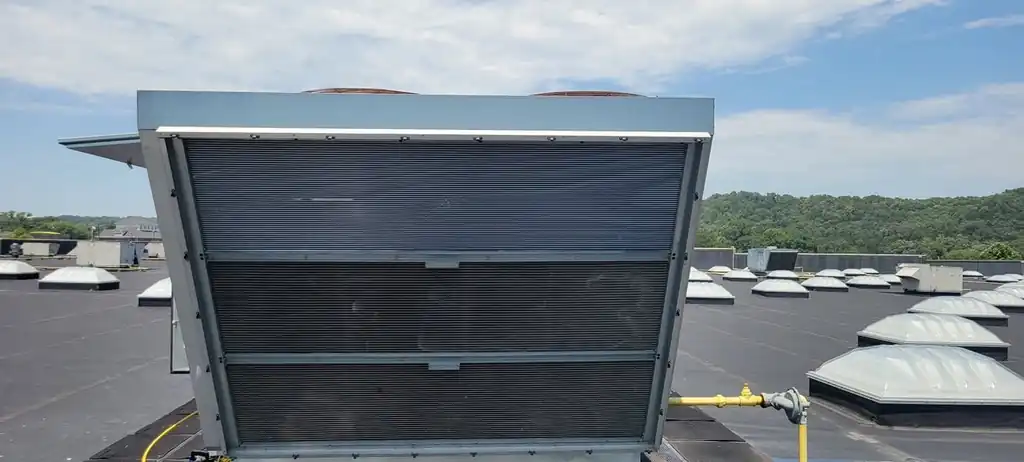
A rooftop HVAC unit with a large condenser coil on a commercial roof, skylights and wooded hills behind
What a controller ties together on a commercial roof
On a typical job the pieces are the same few things. Zone sensors report temperature. The rooftop units and air handlers take commands for fan, cooling and heating stages. A schedule decides when each zone is occupied, and setpoints decide how far the space may drift when it is not. Alarms and trend logs record what actually happened, so a technician is not guessing about last Tuesday.
Every building is different, so the first step is a walk of the equipment, not a catalogue. We look at what each unit can actually accept from a controller, what is already wired, and what would have to be added. Refrigeration is part of that walk when the building has a walk-in, a rack or an ice machine, because a high-temperature alarm on a cooler is exactly the kind of signal that should reach a phone.
Some systems can also bring lighting or security into the same screen. Whether that makes sense depends on the building, and it is a conversation to have before anyone orders hardware.
Chapter 03
After start-up: schedules change, alarms get answered
A controls project is not finished at start-up. Hours change, tenants move, a wall comes down, and the schedule has to follow. A schedule review each season keeps the sequence matching how the building is used, and alarms should go to someone who will act on them. We can help set both up.
The same crew that programs the controller services the equipment it runs, and we answer calls 24 hours a day, 7 days a week. For a building in Springdale or Rogers, that means one phone call at midnight to a crew that knows the roof. Call (479) 325-1075.
Trinity Air Conditioning and Refrigeration · AR HVACR #0003128 · Call (479) 325-1075, open 24/7.
Before the first quote
Questions to settle before a controls project
- Which units can take commands from a controller, and which are stand-alone?
- Who receives an alarm at 2 a.m., and what are they supposed to do with it?
- When does the building really open and close, season by season?
- Do the walk-in cooler and ice machine belong on the same alarm list as the rooftop units?
- Who owns the schedule once the project is handed over?
Bring those answers to a conversation with the crew, or see how controls fit with integrated solutions and rooftop unit service. Current offers are on the specials page, and the phone at (479) 325-1075 is answered around the clock.