Commercial · Compressors
Compressor installation for rooftop units and walk-in refrigeration
A new compressor only lasts when the reason the old one failed gets found and fixed. Trinity sets compressors on rooftop units, walk-in coolers and freezers across Springdale and Northwest Arkansas, any hour of the day.
Chapter 01
A replacement compressor fails fast if the first failure's cause is still in the system
The compressor is the pump that moves refrigerant around the circuit, and it is the most expensive single part on a rooftop unit or a walk-in cooler. When one goes, the owner sees a unit that runs without cooling, a breaker that trips the moment it starts, or a motor that hums and quits. Walk-in boxes drift warm. A restaurant freezer starts to soften at the back of the shelf.
A compressor rarely dies for no reason. Low charge starves it of the cool suction gas that carries heat away from the motor. A dirty condenser coil drives head pressure up. Liquid refrigerant can flood it. A weak capacitor or a pitted contactor makes it start hard, over and over. And when a motor winding burns, acid and carbon travel through the lines, so a new compressor bolted onto those lines is a short-lived repair.
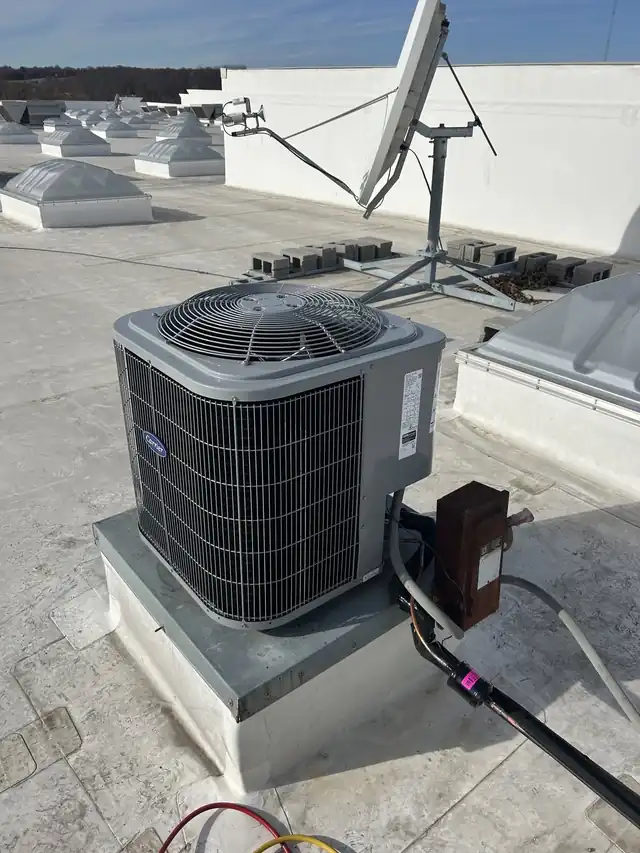
A Carrier condenser on a curb on a commercial flat roof, with skylights and a satellite dish behind it
How a compressor gets set on a Trinity job
The work starts with an evaluation of the system, because the first question is whether the compressor is really the part that failed. Our technicians check amp draw against the nameplate, test the windings, and look at the contactor, capacitor and overloads that sit beside it. Then the refrigerant is recovered and the old compressor comes out. The replacement is matched to the system by refrigerant, capacity and voltage, not by whatever happens to fit the base.
After a burnout, the lines are cleaned and the filter drier is replaced so the new compressor is not fed the old compressor's debris. The mounting gets attention too: vibration isolation, alignment and the electrical connections made to local code. The circuit is pressure tested with nitrogen, pulled down to a deep vacuum, and charged to the right weight of refrigerant.
Then comes commissioning. We run the system and check amp draw, superheat and subcooling, and on units that have them, the crankcase heater and oil return. The job is not finished when the unit starts. It is finished when the numbers are right on the roof, in Springdale or anywhere else in Northwest Arkansas.
Chapter 03
After the new compressor is running
For the first few days, keep an eye on the box or the space the unit serves. A walk-in should pull down to temperature and hold it through the door openings of a normal service. If it does not, or if the unit short cycles or trips a breaker, call (479) 325-1075. The line is answered 24 hours a day, 7 days a week.
Most repeat failures trace back to the same few things: a coil packed with debris, loose electrical connections, and a capacitor that was left in service too long. For restaurants, maintenance and service agreements are available after an on-site assessment. For a home system, the Trinity System Care visits in a membership cover the outdoor unit, the electrical and safety components and the refrigerant system check on a schedule.
Trinity Air Conditioning and Refrigeration · AR HVACR #0003128 · Call (479) 325-1075, open 24/7.
Before it locks out
Signs a compressor is on its way out
These are the calls that turn into installations. If one of them sounds familiar, the sooner a technician reads the amp draw, the more choices you have.
- The breaker trips each time the outdoor unit tries to start.
- The condenser fan spins but the unit never cools the space.
- The walk-in box warms while the condensing unit runs nonstop.
- A hard hum at startup, or a rattle that was not there last month.
- Oil staining around the compressor body or the service valves.
A compressor is often the visible failure and a capacitor, a contactor or a coil is the cause. Our technicians check the whole circuit first. If the unit is older than the repair is worth, ask about a system swap-out or claim $50 off your next service call. Questions go to the contact page or straight to (479) 325-1075.