Replace · Install · Start up
System swap-outs for businesses in Northwest Arkansas
Take out the worn-out unit and set a new one in a planned job, measured to the building and started up by the crew that installed it.
Chapter 01
When another repair stops making sense
A repair makes sense when one part has failed on a system that is otherwise sound. A swap-out makes sense when the system itself is the problem: a compressor that has tripped more than once, a coil that leaks again after being patched, a unit whose parts are hard to find, or a refrigerant that is no longer the one the market is building around. Add up two or three service calls on the same unit and the numbers usually say so.
A swap-out replaces the whole outdoor and indoor package with a new one, in a planned job, rather than in an emergency on the day the old one finally quits. That is the whole argument for doing it early. You pick the day, the building stays comfortable, and the replacement is sized for the space as it is now, not as it was when the old unit went in.
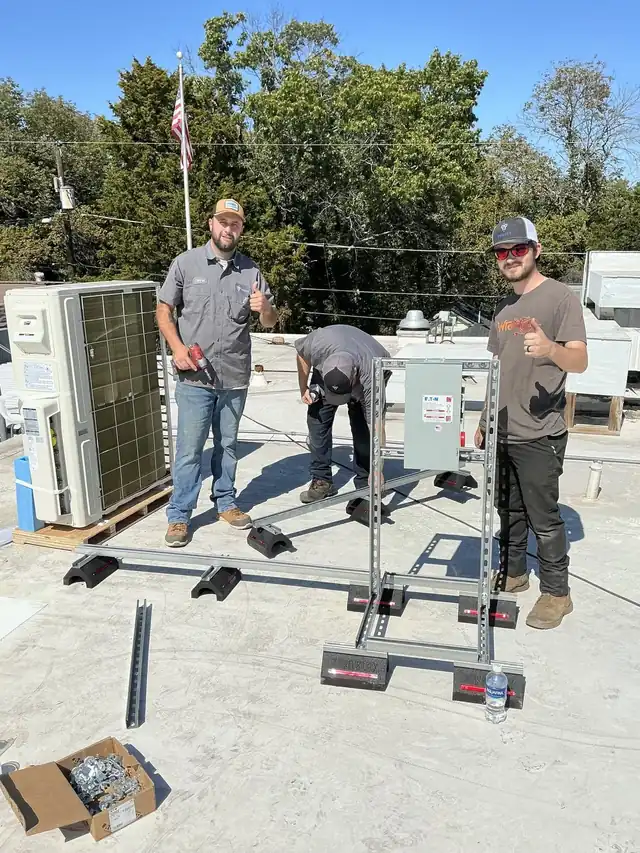
Three Trinity technicians on a commercial roof in the middle of a mini-split install, two giving a thumbs-up, with a flag behind them
How a swap-out runs, curb to commissioning
We start by looking at what is there: the nameplate, the curb or pad, the electrical disconnect, the duct connections or line set, the thermostat and any controls tied to it. We check the new unit against the load the old one was serving and against the roof curb it has to land on, so the replacement fits the same footprint and the same electrical service whenever that is possible.
On the day, the old unit is disconnected and recovered of refrigerant, removed, and the new one is set, leveled, sealed and connected. Power, drain, duct or line set, and controls go back in. Then the part that matters: startup. We check refrigerant charge and pressures, amp draw, airflow and supply and return temperatures, and we confirm that the thermostat is actually in control. The photo on this page shows a Trinity crew mid-install of a mini-split on a commercial roof, on a strut stand.
Large or odd pieces of equipment take planning for access and lifting. Tell us about the roof when you call and we will plan the job around it.
Chapter 03
After the new unit runs
A new system is the easiest one to keep healthy, so that is when to start the routine. Trinity Guardian Care and Priority Plus memberships pair two System Care visits and two HVAC service visits a year with front-of-line scheduling. The signup credit on those memberships ($500 on Guardian Care, $250 on Priority Plus) applies only toward a new HVAC system installation, so a swap-out is where it counts.
If you want to spread the cost, we work with Synchrony financing and the application link is on our financing page. For anything that goes wrong after the install, we are at (479) 325-1075 around the clock, from the shop at 500 Spring St in Springdale.
Trinity Air Conditioning and Refrigeration · AR HVACR #0003128 · Call (479) 325-1075, open 24/7.
Signs it is time
Five signs a unit is ready to be replaced
- The compressor has locked out or tripped breakers more than once.
- The same coil or line has been repaired for a leak again.
- The unit runs all day and the space still will not reach setpoint.
- Parts for the model are hard to find or the lead time is long.
- You have paid for two or three service calls on it in a year.
Plan it
Keep going from here
Not sure whether to repair or replace? Start with RTU and AHU service and repair and we will tell you what we find. A ductless replacement is covered under mini-split installation and service. Read the financing page, see the current specials, or call (479) 325-1075. You can also write to us on the contact page.