Mini-splits · Line sets · Outdoor units
Ductless mini-split installation and service
Heating and cooling for the addition, garage or room your ducts never reached, installed and serviced by the crew at 500 Spring St.
Chapter 01
A room the ducts never reached
Most ductless installs begin with a room that does not work. It is an addition that was tied into the old system and never got enough air, a garage that was turned into a workshop, a sunroom, a finished space over a garage, or an older house with no ducts at all. Extending a duct run into a room like that means cutting open ceilings and walls, and the existing air handler may not have the capacity to carry the extra space anyway.
A mini-split gives the room its own heating and cooling without touching the rest of the house. It has no duct run to leak, it can be set to a different temperature than the rest of the house, and it is quiet inside because the compressor is outdoors.
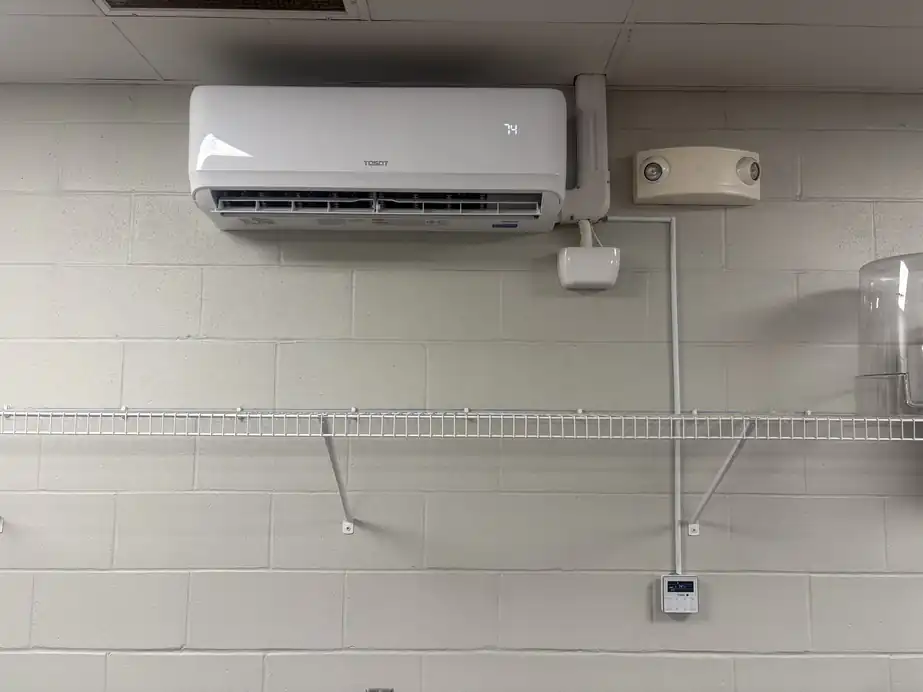
A ductless mini-split head mounted on a painted block wall above a wire shelf, with its line set and thermostat below
Head, line set and outdoor unit: how a mini-split goes in
A ductless system is three parts. The indoor head mounts high on a wall and blows the conditioned air. The outdoor unit holds the compressor and sits on a pad or a wall bracket. A line set, copper refrigerant lines plus a power and control cable, runs through a small hole in the wall between them, along with a condensate drain.
We start by choosing where the head can throw air across the whole room without blowing on a bed or a desk, and where the line set can run with the shortest, neatest path to the outdoor unit. The lines are flared or brazed, pressure-tested, then evacuated before refrigerant is released, because moisture or air left in the lines shortens the life of the compressor. The condensate drain has to fall away from the head, and we check that it does before we leave.
The same approach works on a block wall, a wood-frame addition or a flat roof where the outdoor unit has to sit on a stand.
Chapter 03
Keeping the filters and the drain clean
Mini-splits ask for less than ducted systems, but what they do ask for matters. The washable filters behind the head grille clog with dust and pet hair and the coil behind them follows. A drain line that clogs backs water up into the head, and the first sign is dripping or a musty smell from the unit.
On our service visits we clean the filters, check the coil and the drain, look over the line set insulation where it runs outdoors and test the system against its controls. The Trinity System Care checklist covers Drainage and Moisture Control for exactly this reason, and both of our memberships include two System Care visits a year. If a head stops cooling at midnight in July, call (479) 325-1075. We answer all night in Springdale and across Northwest Arkansas.
Trinity Air Conditioning and Refrigeration · AR HVACR #0003128 · Call (479) 325-1075, open 24/7.
Good places for a mini-split
Rooms where ductless usually makes sense.
- A room addition or sunroom the existing system cannot keep up with.
- A garage, shop or bonus room over a garage.
- An older house with no duct system to extend.
- A bedroom or office that needs its own temperature.
- A building where one outdoor unit has to serve several rooms, which is VRF territory.
Ask about the $500 or $250 signup credit.
Membership signup credits apply only toward a new HVAC system installation. They are not monthly, have no cash value and do not apply to repairs or maintenance.
See the memberships