Load calculations · Sizing · Design
System design and engineering for Northwest Arkansas homes and businesses
Site assessments, load calculations and equipment selection, so the system that goes in is the right size for the building it serves.
Chapter 01
A system that is the wrong size is wrong every day
An oversized air conditioner cools the room fast, shuts off, and leaves the air cold and damp. It short-cycles all summer and wears its start components faster than it should. An undersized one runs from noon to midnight and never catches the house. Neither one is a repair problem. Both were decided on the day somebody picked the equipment.
Engineering, at Trinity, means getting that decision right before the old unit comes out. It covers the measurements, the calculations and the choices about equipment, ductwork or piping, and electrical service that make a new system fit the building it is going into.
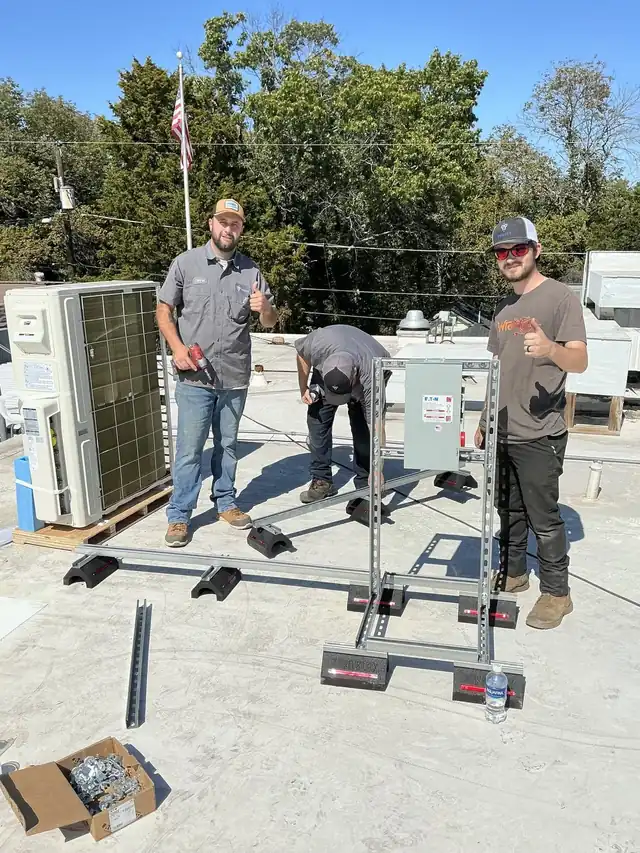
Three Trinity technicians on a commercial roof during a mini-split installation, two giving a thumbs-up, with a flag behind them
From site assessment to load calculation to an equipment list
It starts with a walk of the building. We look at the envelope, the windows and sun exposure, how many people use the space and what equipment gives off heat in it. We check the existing duct or line routes, the electrical service available at the panel, and whether a roof curb or a pad can carry the new unit.
From those numbers comes a load calculation, which is the actual cooling and heating the space needs rather than a guess based on the old unit's nameplate. The equipment list follows from the calculation. The systems we design and install include central air conditioning, heat pumps, ductless mini-splits, geothermal systems and commercial refrigeration units.
On a commercial job the same method applies to a walk-in cooler or a rooftop package unit: what heat load goes in, what temperature has to come out, and what the building allows. We design and install, so details that matter on the roof are not lost between the office and the truck.
Chapter 03
Hand-over: start-up, documentation, and the first maintenance visit
A new system is tested before we leave: pressures, temperatures, airflow and electrical readings are checked against what the design called for. We walk the owner through what was installed and leave a plain summary of the system's status, the same habit our Trinity System Care visits follow.
After that, the equipment is one phone call away at any hour. Homeowners can put the system on a Trinity membership, and the signup credit applies toward a new HVAC installation. Call (479) 325-1075 to talk through a project in Springdale, Rogers, Bentonville or anywhere in Northwest Arkansas.
Trinity Air Conditioning and Refrigeration · AR HVACR #0003128 · Call (479) 325-1075, open 24/7.
First conversation
What to have on hand
- Nameplate photos of the equipment you have now
- A note of which rooms or areas are never comfortable
- Building plans, if you have them
- A year of utility bills, if you can find them
- Anything that is changing: an addition, new tenants, new equipment
None of that is required. If you only know the system is not keeping up, we can start from the building. When you are ready, send us a request or call (479) 325-1075.
A homeowner replacing a system can also look at the Trinity memberships, whose signup credit applies toward a new HVAC installation, or the current specials.