Ground loops · Water-source heat pumps
Geothermal heating and cooling in Springdale
A ground-source heat pump that trades heat with the earth through a buried loop, installed and serviced by a family-owned Springdale crew.
Chapter 01
Using the ground as the heat source
A few feet below the surface the ground holds a steady temperature all year, while the air above it swings from a freezing January night to a July afternoon in the nineties. A geothermal system takes advantage of that difference. Instead of pushing heat into hot outdoor air in summer or pulling it out of cold air in winter, it exchanges heat with the ground through a loop of buried pipe.
Indoors, the equipment is a water-source heat pump that looks much like a furnace-sized cabinet. In summer it moves heat out of the house and into the loop. In winter it pulls heat out of the loop and into the house. There is no outdoor condenser fan, no outdoor coil to ice over, and no gas flame.
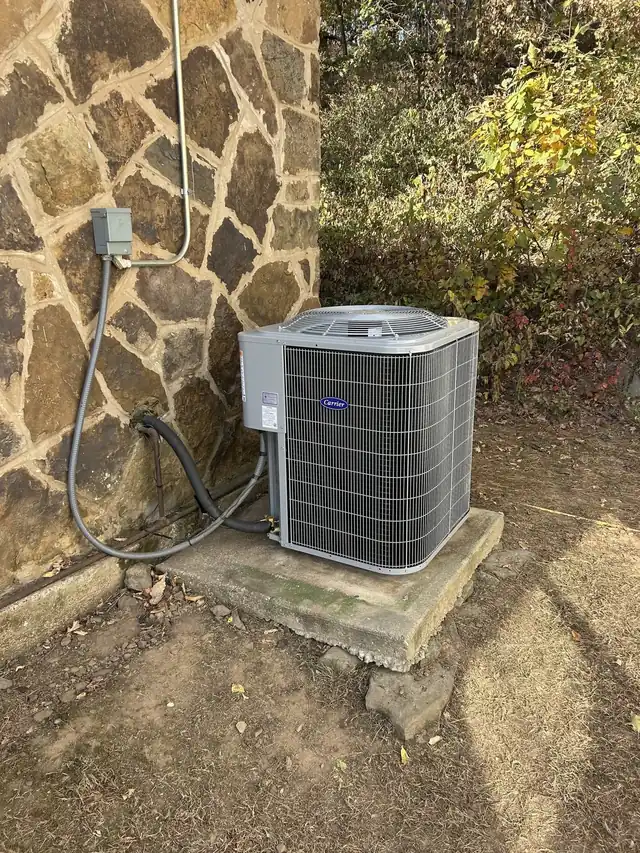
A new Carrier condenser on a concrete pad against a fieldstone wall with autumn woods behind it
Closed loop or open loop, horizontal or vertical
Most residential systems are closed loop: a sealed run of pipe filled with a water and antifreeze solution that circulates between the ground and the heat pump. A horizontal loop is laid in trenches and needs room. A vertical loop goes down boreholes and needs far less land. A pond or lake loop coils the pipe on the bottom of a body of water on the property.
An open-loop system draws water from a well, passes it through the heat pump and returns it to a second well or a drainage path. It only works where there is enough groundwater and local rules allow it, so it is the less common choice.
Which configuration fits depends on the lot, the soil and the load the house puts on the system. We begin with a site evaluation and a load calculation, and we handle the permits. Trinity installs several loop configurations, and we will tell you plainly if your property points toward one over another.
Chapter 03
Service on a system that is half underground
The buried loop itself needs little attention. What does need it is the equipment inside the house: the heat pump, the blower, the electrical connections, the circulation pump and the condensate drain. We check pressures, flow, temperatures across the loop and the controls, the same way we work through the System Care checklist on any other system.
If a geothermal system stops heating at 2 a.m. in January, the water-source heat pump is where we start, and we answer the phone at (479) 325-1075 through the night. Springdale, Lowell, Rogers, Tontitown and the rest of Northwest Arkansas are all within our service area.
Trinity Air Conditioning and Refrigeration · AR HVACR #0003128 · Call (479) 325-1075, open 24/7.
Before you decide
Questions to answer about the property first.
- How much open land is there for a horizontal loop?
- Is a vertical bore a better fit for a small or sloped lot?
- Is there a pond, or a well with enough water, on the property?
- Is this a new build, where the loop can go in before landscaping?
- What will the heat pump replace, and are the existing ducts sound?
- Do you want it to carry the whole house or only part of it?
If the house is still on the drawings, start with new construction. If you are comparing geothermal with an air-source heat pump or a ductless system, see heat pumps and ductless HVAC. Financing is available through Synchrony.