Small-duct heating and cooling
High-Velocity Heating and Air Conditioning
Central comfort for homes that cannot take a duct trunk, installed in Springdale and across Northwest Arkansas.
Chapter 01
The house that never had room for ductwork
A lot of Northwest Arkansas homes were built before anyone planned for central air. There is no attic with headroom, no chase between floors, and no soffit wide enough to hide a duct trunk. The usual answers are window units, space heaters and one upstairs bedroom that is ten degrees off from the rest of the house.
Standard ductwork is the problem, not the idea of central comfort. A conventional trunk and branch system needs a duct as wide as a shoebox running through the structure, and tearing open plaster and finished ceilings to fit one is a bigger job than the equipment itself.
A high-velocity system is built for exactly that house. If you have a room that never keeps up, a finished attic that was never conditioned, or an addition that outgrew the old furnace, it is worth a look before you give up on central heating and cooling.
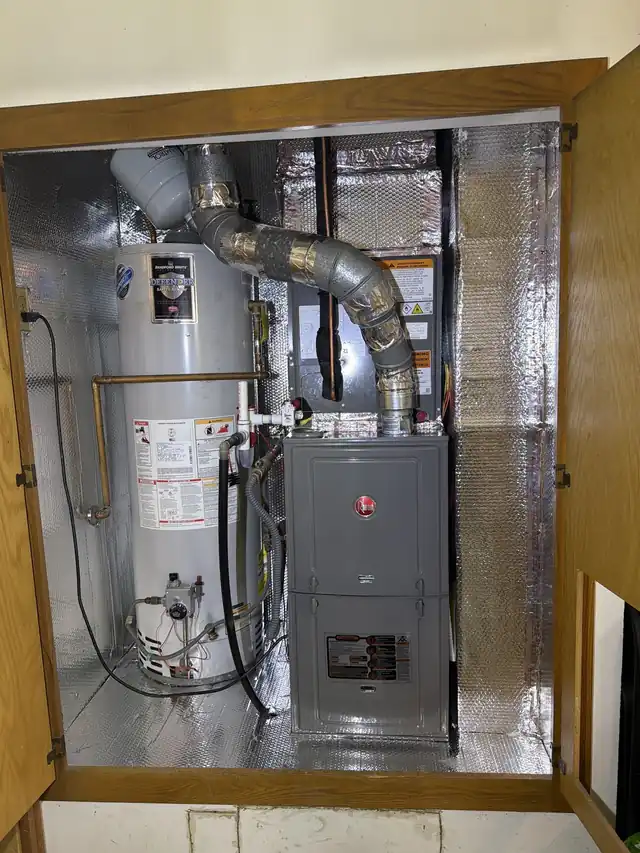
Rheem gas furnace and water heater installed in a foil-lined closet with a new flue pipe
How the small-duct system gets air where it needs to go
The equipment is a compact air handler with a coil, paired with an outdoor unit for cooling and a heating source for winter. Instead of one large trunk, it sends conditioned air through flexible supply tubes about two inches across. Those tubes snake through the gaps that already exist in the framing, then end in small round outlets in the wall, ceiling or floor.
The air leaves those outlets fast, which is where the name comes from. The velocity mixes the room air as it arrives, so you do not get the cold stream and warm corner you get from a lazy register. The tubes are insulated, so the air does not lose its temperature on the way through a hot attic or a cold crawlspace.
Our technicians walk the house first and look at where the framing will let a tube pass, where the air handler can live, and how big the load is in each room. That survey decides the layout. It also tells us honestly when a different system, such as ductless mini-splits, is the better fit for your house, and we will say so.
Chapter 03
Keeping a small-duct system quiet and clean
These systems run quieter than most homeowners expect. The outlets are small, the tubes are insulated, and the air handler is sized for the job. If you hear whistling or a new rattle, it usually points to a loose outlet, a kinked tube or a dirty filter, and any of those is a quick fix.
Because the air moves through tight runs, filter and coil care matters more than it does on a roomy trunk system. A clogged filter shows up as weak airflow from the farthest outlet first. The Trinity System Care checklist covers airflow and filtration, the refrigerant system, the outdoor unit and drainage, which is the list we run on every maintenance visit.
If the system stops on a freezing night or a July afternoon, call (479) 325-1075. We are open 24 hours, seven days a week, and a Trinity Guardian Care or Priority Plus member gets front-of-line scheduling.
Trinity Air Conditioning and Refrigeration · AR HVACR #0003128 · Call (479) 325-1075, open 24/7.
Where it fits
Houses and rooms we point to a small-duct system
If your house looks like one of these, ask for a survey. We will tell you whether high-velocity is the right call or whether a heat pump or ductless system fits better.
- Older homes with plaster or finished ceilings you do not want opened up
- A second floor or finished attic that the existing system never reached
- Home additions and sunrooms the old furnace was never sized to carry
- Apartments and condominiums where each unit needs its own system
- Historic houses where the character of the walls matters
Heating and cooling replacement can be financed through our Synchrony financing page, and the $50 off your next service call offer is posted on our specials page. Questions about your house? Call (479) 325-1075 or use the contact form.